Prague is definitely the most stunning city that we have ever seen, such a medieval feast for the eyes and being there is like wandering through a fairytale land. Behind the veil of beauty though, is a city (and country) with scars. There are the obvious wounds of war and the hardship war creates, but what we learned, was that up until only 20 years ago, the people lived under a ruthless communist rule. After our visit to the Communist Museum, we really grasped for the first time how oppressive this political ideology is and just how much it robs people of their freedom, of identity, of personal expression and achieving their personal dreams. On top of all that we learned and had seen in the last few weeks in relation to war, Governments and people’s suffering, we felt so deeply appreciative for the freedom that we as Australians have enjoyed for generations. The challenge for us, especially when we return home, is to use our freedom wisely, with great intention and to guard ourselves from one of freedom’s major enemies – apathy.
Thursday, August 26, 2010
Appreciating our freedom

Wednesday, August 25, 2010
Krakow Underdone
In a nutshell, we left Krakow wanting more, but knowing that we needed to keep moving. Despite experiencing some frustration, our time in there definitely wasn’t a waste. One major highlight for us was meeting some Polish couch surfers (Chris & Ewa) in the city, who ended up inviting us back to their home where we ate home made carrot soup and traditional Hungarian/Polish goulash. The veggie drought was finally broken and our bodies were extremely thankful! An absolutely lovely couple who we wish we could have spent more time with, but we appreciated again, the connections that ‘couch surfing’ facilitates.


Tuesday, August 24, 2010
Saturday, August 21, 2010
Surviving Auschwitz
To give you a very incomprehensive background… Auschwitz, located in Oswiecim outside of Krakow, Poland, has become a major symbol of the Holocaust. Approximately 1.1 million completely innocent people were systematically murdered in the gas chambers of this camp, 90% of them Jews. Most people arriving by train never actually entered the camp, but just crossed it on their way to the gas chambers after being selected for extermination based on their inability to work. The minority, chosen for slave labour became registered prisoners with shaved heads in striped uniforms. They were stripped of everything, including their personal identities, which were replaced with a numbered tattoo on their arm or chest. They lived in the most inhumane conditions and worked a minimum of 11 hours per day and consuming the smallest of food rations. Many people died of starvation, exhaustion or disease from poor living conditions. High electric barbed wire fences surrounding the camp were guarded by SS soldiers armed with machine guns or rifles. Prisoners were beaten or shot dead for the most trivial behaviours such as looking at an SS guard the wrong way or refusing to work due to exhaustion. A regular ‘selection’ process was also conducted to send any ‘unproductive’ prisoners to the gas chambers and to also make way for new comers.
On the day of our visit, the sky was clear and the sun shone brightly, which did feel a bit strange considering the ‘darkness’ and evil of this place. We walked through the arched entrance which read ‘Arbeit Macht Frei’, meaning ‘work makes you free’. My stomach churned thinking about the irony of those words and how the people entering these gates were deceived into thinking they were in transit, which was obviously not the case. The grounds didn’t look much unlike a high security prison, but the difference was that most of these prisoners were ordinary civilians like you and me, people with good professions and high moral values. To think that whole families were tortured and murdered in this place was just mind-boggling.


It was an eerie feeling to walk into the only gas chamber left standing, knowing thousands of people met their death in that very room. We were utterly horrified to learn that the gas caused death by suffocation and took about 20 minutes. The bodies, including every opening, were then searched for anything valuable, which was then extracted. Simply nauseating. What was hard to accept was how any human being could carry out these atrocious tasks on another human being. It was the epitome of evil.


Over the years, the camp was expanded, with over 40 subcamps. We also visited the second major camp - Auschwitz Birkenau, the one depicted in most of the Holocast films including Schindler’s List. A huge 400 acre field with train tracks lining the centre, through the famous brick arch. Here we saw the appalling conditions in which the prisoners lived….bunk beds lining the horse stables with concrete floors where up to 10 people slept and where some often died from suffocation. The toilet block featured holes in concrete where prisoners were only allowed to enter twice per day and were beaten while in the process if they didn’t hurry. It was here that we heard about the prisoner’s courage and determination to survive, to support each other and to smuggle in necessary items to stay alive. We saw some art work painted by a survivor which depicted some men returning from a days work and some were carrying others. A very powerful image of the endurance of the human spirit. Our guide recommended a book with a title that inspired me instantly…it’s called ‘Hope is the Last to Die’, one woman’s personal journey of surviving the camp and how she maintained her belief in human goodness. One that I would definitely like to read.

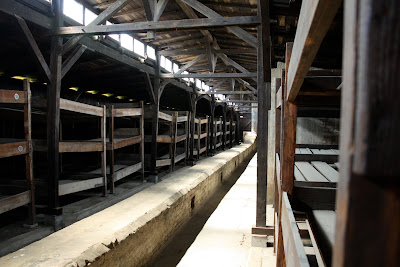
For our final part of the tour, we walked in the footsteps of the victims from the time they disembarked from the train and were selected for extermination, to the moment they stood waiting in front of the gas chambers. All I could do was be silent and try to imagine what these people may have felt, most of who had no idea they were walking to their deaths. As we stood in front of the remains of the gas chambers (they had been demolished by the SS as the war was ending in an attempt to hid the evidence), I felt completely numb, emotionless even, which is extremely unlike me! I suspect, that it may have just been my brain’s way of coping with something so achingly painful and this whole experience will take a while to process.I will conclude this post with a series of questions asked by someone on our tour which instigated a very confronting response from the guide… “Didn’t anyone know this was happening and what about the smell coming from the camp? Why didn’t anyone do anything?” The response: “Suffering continues in our world and people still get caught up in their own lives with their small problems”. A slap in the face and very well said! Something to think about.
Wednesday, August 18, 2010
Scratching the Surface of History in Berlin (Aug 11-17)
Both tours went for about 3 hours and we visited some of the major sights during that time and heard a general history of Berlin, the world wars, the Cold War and particularly the rise and fall of the Nazis. As we walked through the city, we saw:
- The Reichstag (German Parliament building);
- The Brandenburg Gate, in which anyone coming to Berlin in the early years were required to enter through;
- A site where a remaining section of the Berlin Wall still stands and is also home to ‘Checkpoint Charlie’, the Soviet border crossing dividing East and West Berlin during 1961-1989 when the wall fell;
- The memorial to the Murdered Jews of Europe (Holocaust Memorial);
- The site of Hitler’s bunker where he also committed suicide. The site has purposely been left bare with no form of any memorial for obvious reasons;
- The last remaining Nazi building, which was once home to the Nazi Aviation Ministry. It is an extremely intimidating building with solid lines and granite materials used to stand the test of time;
- The book burning memorial, which commemorates the 1933 event where the Nazis burnt over 25,000 ‘un-German’ books and
- The Jewish Quarter including a major Synagogue and cemetery.


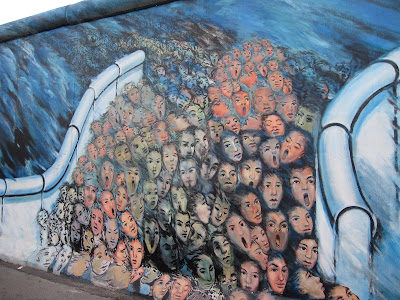

While I am definitely not a history writer and will therefore spare you from any lame historical descriptions of the places we visited (I’ll leave you to google them and read for yourself), I can tell you about the impact they had on us and how our interest in learning more about modern history has changed…..there is something different about visiting a place and being told the story then and there, rather than reading it from some history book in school. Maybe what we had learned as a teenager seemed abstract and more like a story, while being here and seeing where it all took place brought it to life and made it real.
The human devastation, hardship, torture and murder perpetrated by the Nazis was what disturbed us the most. We saw images and read stories, not only of the murdered Jews, but also gypsies, homosexuals and any other ‘outcast’ who was deemed ‘unfit for work’. We were shocked to learn that over 70,000 people who were mentally ill or physically/mentally disabled were also murdered in gas chambers. The Nazis labelled them ‘useless eaters’ or ‘life unworthy of life’ and justified their murder as ‘euthanasia’, using the propaganda of ‘putting them out of their misery’. The evil of what took place not only in Germany, but across Europe as the Nazis gained power, is literally sickening. I have never experienced instant nausea bordering on the urge to vomit until being exposed to these images and stories in the place where they occurred.
The experience was personalised for us when we visited the Jewish Museum and went inside what has been named the ‘Holocaust Tower’. We were there just before closing time and entered an iron door unaccompanied. We were instantly surrounded by four concrete walls at least 5 storeys high and in complete darkness besides a small ray of light strategically shining high in one corner. The iron door slammed shut behind us and sounded as if it was being latched which echoed off the walls. I instantly went into a panic inside and scrambled for the door to make sure it was still open. It was the feeling of fear and suffocation of those walls that made me want to get out of that nauseating enclosure immediately. Despite wanting to get out of there right away, we decided to stay and allow those feelings to be, without the need to escape them. Maybe that afternoon, we caught the tiniest glimpse of what it was like to experience the terror of living under the Nazi regime. It was a powerful exhibition to say the least.
Before Berlin, our biggest aim for travel was to experience food, wine and culture through meeting local people. Where we have previously been a bit uninterested with learning about some historical events, visiting museums or viewing pieces of architecture, we realise now that all of these are key pieces of the puzzle if we truly want to discover a culture. Sure, some of what we see and read may not always arouse our interest, but our experiences in Berlin have made us more open to learning and to appreciate the importance of history a little more.
Leaving Berlin after 6 days was difficult because we literally felt like we had only scratched the surface and there was so much more to discover. Unfortunately, the weather wasn't very kind to us and rained every day we were in Berlin which made squeezing things in a little difficult. It would have taken us another two weeks (at least) to visit the museums and other sights we were interested in, but we knew we had to move on, especially knowing there will be many more places we will have to tear ourselves away from. In particular, we were disappointed to have not visited the Sachsenhausen Concentration Camp, which was the first ‘model’ camp the Nazi’s implemented. We were mindful however that we were on our way to Krakow in Poland to visit the Auschwitz concentration camp, so we let it slide. All in all, we were thankful for what we had the opportunity to see and learn.

